

Ganbei! Understanding the Art of the Chinese Toast

If you only have one word to remember from Chinese drinking culture, it's this: Ganbei (干杯), pronounced "gann-bay" and literally meaning "dry glass", or bottoms up. Yet, behind this simple word lies a whole art of living, a social code of unsuspected richness, and a true diplomatic tool that has accompanied Baijiu for centuries.
A tradition more than 2,000 years old
The Ganbei tradition is said to date back to the Qin Dynasty, between 221 and 206 BC, a time when it was common to drink from large communal bowls. To ensure everyone received their fair share, it was customary to empty one's bowl in a single gulp.
From this practice, the expression Ganbei was born, as well as a whole philosophy of drinking together that has been passed down, codified, and enriched through the dynasties to this day.
The table, a social stage
In China, Baijiu is almost never drunk alone, as it primarily accompanies meals and banquets where it plays a fundamental social role. The Chinese table is not just a place to eat: it is a space for negotiation, seduction, and relationship building, where every gesture around the glass is meaningful.
Hierarchy is omnipresent, as it is always the host or the highest-ranking person who opens the festivities by giving the first toast. When toasting with a superior, the rule is to hold your glass slightly lower than theirs, this small, discreet gesture encapsulating the entire philosophy of respect and deference that permeates Chinese culture.
One fills their neighbor's glass before their own, one responds to every toast made to them, and not doing so would be considered an unforgivable affront.
Guanxi: drinking to build connections
To understand why all this is so important, one must grasp the concept of guanxi (关系), this network of personal relationships upon which much of social and professional life in China rests, and which determines the trust given in business as much as one's reputation.
Where a Westerner might be tempted to drink in moderation to maintain control of the situation, a Chinese person, on the contrary, considers the disinhibition associated with sharing drinks as an invitation to get closer and truly get to know each other. Refusing to participate in Ganbei therefore risks never forging this essential guanxi with the people around the table, and forever remaining a stranger in their eyes.
The rules to know
If you ever find yourself at a Chinese table, a few principles naturally impose themselves with practice. One waits for all the dishes to be served before giving the first toast, one never drinks alone as the glass is always raised towards someone, and refusing a Ganbei is particularly ill-advised unless a serious medical reason is invoked.
However, if the evening drags on and drinks flow at a steady pace, there is an elegant way out with the word suíyì (随意), which means "at your leisure" and allows everyone to drink at their own pace without losing face.
When Baijiu seals historical agreements
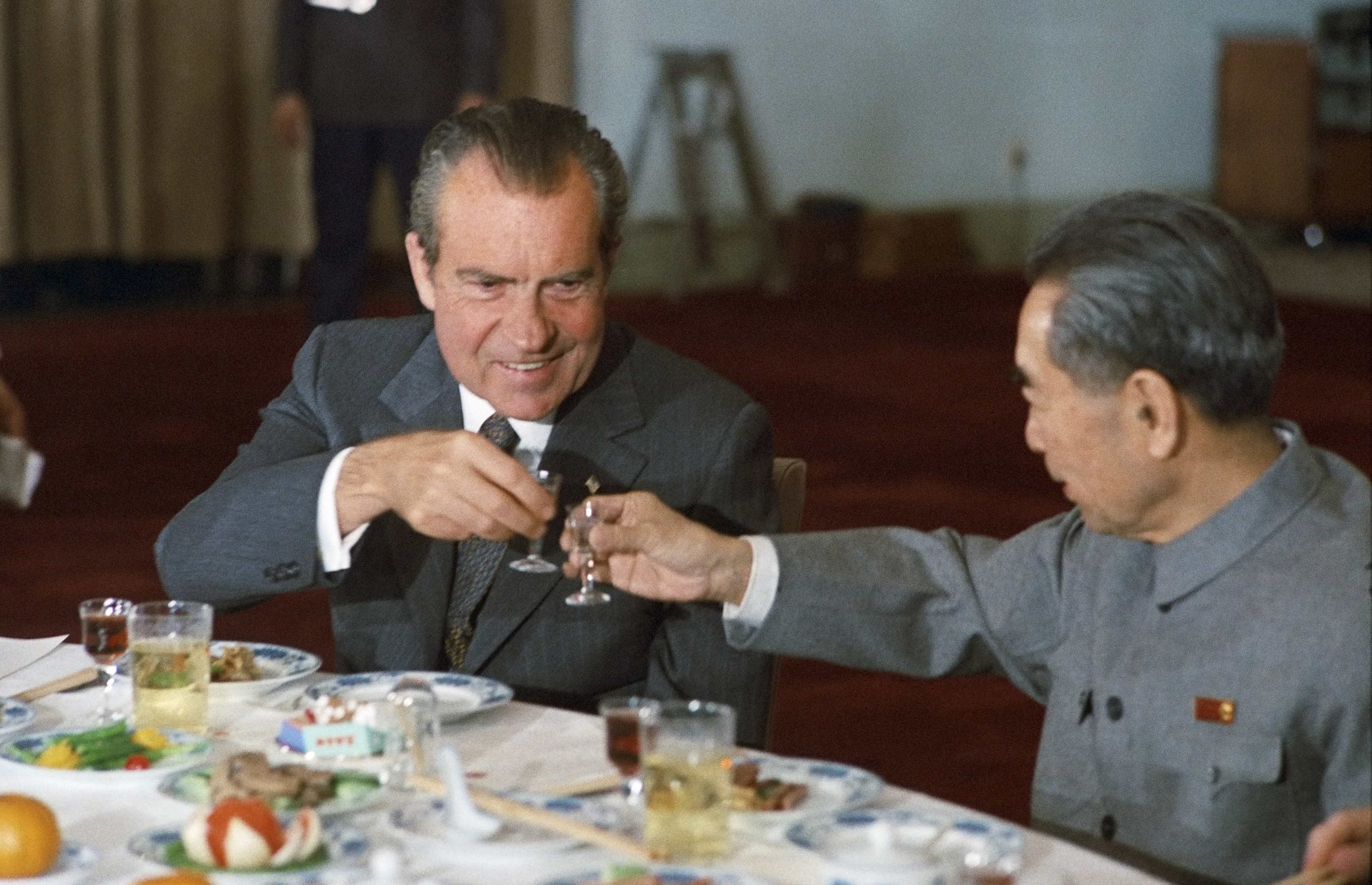
Ganbei is not just an evening ritual among friends or colleagues; it has also played a role in major historical events. During President Nixon's visit to China in 1972, it was notably over shared glasses of Baijiu at a state banquet that Sino-American relations truly began to warm up, to the point that Nixon brought back a few bottles in his luggage upon his return.
,%20pronounced%20%22gann-bay%22%20and%20literally%20meaning%20%22dry%20glass%22,%20or%20bottoms%20up.%20Yet,%20behind%20this%20simple%20word...)